Lost Bay's shoreline wetlands
About
Named for the eastern arm of Gananoque Lake, the Lost Bay Nature Reserve is 268 hectares (662 acres). It is considered part of the Algonquin to Adirondack Connection (A2A) because it is located within the Frontenac Axis – the southernmost part of the Canadian Shield that forms the Thousand Islands.
These islands provide a bridge for plant and animal species to cross the St. Lawrence River, which enables wildlife to travel within the corridor between the two parks in response to environmental change, maintaining both population and genetic diversity.
Spotted salamander © Smera Sukumar
Plants and Animals
The nature reserve is home to at least 33 species at risk and 18 rare species, including Blanding’s turtle, and eastern musk turtle, golden-winged warbler, western chorus frog and flooded jellyskin.
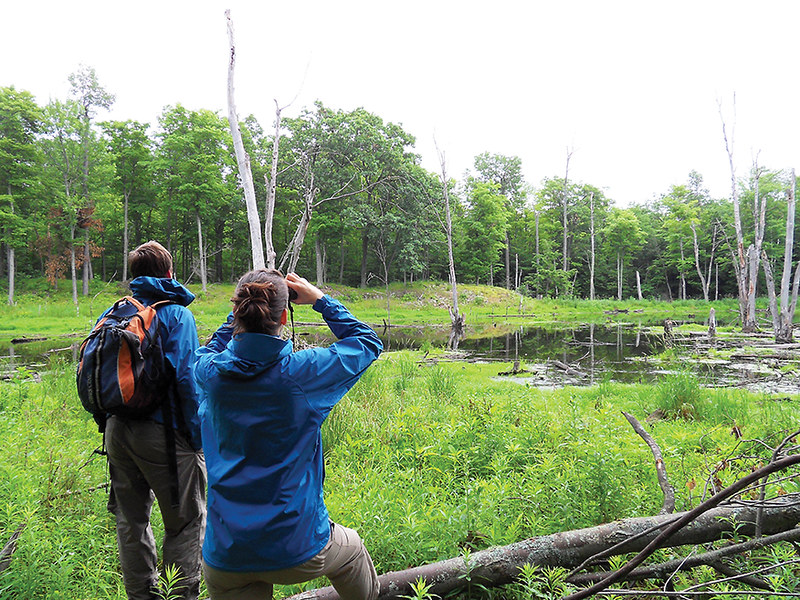
About three-quarters of the property is forested and the remainder is predominantly Provincially Significant Wetlands, which provide habitat for important reptiles, birds and mammals. Ducks, especially wood ducks, are often seen foraging for food and sheltering in the marshes. The relatively undisturbed wetland areas, linked by natural corridors of forest, provide excellent habitat for birds such as the red-shouldered hawk, great blue heron and osprey. Songbirds, including black-capped chickadees and yellow warblers, nest in the tall maple trees nearby.
As one of the few mature stands in the area, the nature reserve’s hemlock forests shelter deer from the elements.
Blanding's turtle © Tracy Parker
History
In October of 2000, the dream of linking the woods and wetlands of Ontario’s Algonquin Park to New York State’s Adirondack Mountains became a step closer to reality. Local landowners saw an opportunity to protect 44 hectares of Provincially Significant Wetlands and mature forest around Lake Gananoque. With the generous help of local donors, the Nature Conservancy of Canada acquired the Lost Bay Nature Reserve. Shortly afterwards, the nature reserve was turned over to Ontario Nature.
White admiral butterfly © Noah Cole
Expansion
In the fall of 2009, Ontario Nature purchased an additional 59 hectares of Provincially Significant Wetlands and mature forest, which it added to the nature reserve, again with the help of generous local donors. In 2011, Ontario Nature added another 95 hectares to the nature reserve. This property is named the Summerfield Tract in memory of Debra Summerfield whose family made a generous contribution in her name. In 2014, a nature-loving couple sold their 40-hectare property connecting two separate parcels of the nature reserve. Having cared for the property’s wildlife and natural habitats for 25 years, they wanted to make sure that Ontario Nature had the opportunity to add it to the adjacent nature reserve.
In 2024, our community rallied to once again expand the nature reserve by supporting the purchase of a 50-acre property, which connects surrounding wetland and terrestrial habitats. In 2026, Ontario Nature purchased an additional 18-acre parcel, further strengthening this critical linkage for terrestrial and aquatic species to move within the Frontenac Arch.
Lost Bay Nature Reserve © Melissa Thomas
Stewardship
The Lost Bay Nature Reserve is currently stewarded by dedicated local landowners.
We are looking for additional stewards to join Lost Bay Nature Reserve’s stewardship team. To learn more, please visit our Volunteer as a Steward webpage.
Lost Bay Nature Reserve © Kirsten Dahl
Visiting
Direct access to Lost Bay Nature Reserve is limited due to a lack of parking. We recommend visitors to view the property’s beautiful shoreline by boat, kayak or canoe from Lost Bay. We encourage prospective visitors to reach out to the nature reserves team for information about property access.
If you have any questions, please contact us at 416-444-8419.
We do not charge a fee for entrance and there are no operating hours on any of our nature reserves. Properties are monitored by volunteer stewards. We rely on visitors to be safe, minimize their impact on nature and be respectful of others. For more information about visiting the nature reserves, please read our Permitted Activities Policy.
Lost Bay © Kirsten Dahl
Lost Bay Nature Reserve
Photo Gallery
The Lost Bay Nature Reserve is generously supported by: